A Stroke at 19: How Fast Action Helped Save a Young Man’s Life

June 24, 2026

“He told me he couldn’t feel his whole right side.”

When 19-year-old Jaylen called out for his mother from the bathroom, she immediately knew something was wrong. His words sounded garbled. When she rushed in, she found him on the floor unable to move the right side of his body.

“He was talking to me, but I couldn’t really understand him,” his mother, Whitney, recalls. “He told me he couldn’t feel his whole right side.”

As frightening as the moment was, she recognized the signs immediately. Although strokes are often associated with older adults, she knew the symptoms: facial drooping, weakness, and speech difficulty. She asked him to smile, and when only one side of his face moved, she called 911 right away.

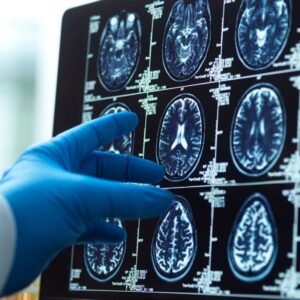
What happened next was a rapid chain of events that helped save his life and likely prevented permanent disability. After arriving at the Emergency Department at Lakeland Regional Health, Jaylen was immediately sent for imaging, where physicians discovered two blood clots on the left side of his brain, causing a large vessel occlusion (LVO) stroke.

An LVO stroke is a medical emergency. For every minute a large vessel occlusion remains untreated, millions of brain cells die. This could quickly result in devastating brain injury if not treated immediately. Within minutes, Dr. Sheyar Amin and his Comprehensive Stroke Team at LRH coordinated advanced treatment to restore blood flow and minimize brain injury.

“I love Dr. Amin. He’s amazing. He came and he talked to us and explained what was going on. I was very impressed with the ER, Interventional Radiology,and ICU. They were all amazing,” says Whitney.

The patient received TNK, a clot-busting medication used in certain types of stroke, before being rushed to Interventional Radiology for an emergency thrombectomy procedure to physically remove the clots.

“They were able to remove the two blood clots,” his mother says.

During the procedure, the physician identified an additional blockage affecting blood flow to the eye and effectively treated it to help preserve vision.

Despite the severity of the stroke, Jaylen’s recovery began almost immediately. By the time he arrived in the Neuro ICU, he was already able to move his right side. Just hours later, he was awake and speaking again. “By Friday night, early Saturday morning, he was fully recovered,” his mother says. “He could talk normally. He could move everything. It was like he hadn’t even had a stroke.”

Further evaluation revealed an underlying medical condition that likely contributed to the stroke and is now being actively managed. For Jaylen and his mother, the experience reinforced how critical it is to recognize stroke symptoms quickly and seek emergency care immediately.

One detail stayed with her after the ordeal. Her son told her he believed he was having a stroke while it was happening. How did he know?

“He told me later that he had seen a video on TikTok about the signs of stroke,” she says. “He said he was hoping I would recognize it, too. When I asked him to smile, he knew I understood what was happening.” His mother’s quick response and the rapid emergency care he received made all the difference.

Know the Signs of Stroke

Stroke can happen at any age, and early recognition is critical. Rapid treatment can stop stroke, save more brain, reduce disability, and improve recovery and outcomes.

Remember the warning signs with the acronym BE FAST:

  • Balance loss
  • Eyes/vision changes
  • Face drooping
  • Arm or leg weakness
  • Speech difficulty
  • Time to call 911

Comprehensive Stroke Center

As the first and only Comprehensive Stroke Center serving Polk County, Lakeland Regional Health provides 24/7 access to advanced, world -lass comprehensive stroke care, including thrombolytic therapy, mechanical thrombectomy, neurocritical care, aneurysm and brain hemorrhage care, along with specialized rehabilitation services.

Share: